

Table of Contents

Introduction
Remember that moment when you just knew what to do, even when everyone else was giving you different advice? Or that time you felt strangely calm during a crisis while others panicked? That’s often your Higher Self peeking through.
We all have this wiser part of ourselves, though most days it gets drowned out by busy schedules, social media notifications, and that inner critic who never seems to take a day off. But connecting with your Higher Self isn’t some mystical achievement reserved for people who meditate on mountaintops—it’s available to all of us, even on ordinary Tuesdays when you’re stuck in traffic or doing the dishes.
Let’s talk about what this Higher Self really is (in plain English), how to tell when you’re actually in touch with it, and simple ways to strengthen that connection—no complicated spiritual jargon required.
What Is the Higher Self?
Think of your Higher Self as the most authentic version of you—the part that remains when you drop the masks, the people-pleasing, and the constant worrying about what others think.
It’s like your inner wisdom has your back even when your brain is spinning worst-case scenarios. While your everyday thinking mind (sometimes called the ego) is busy managing your to-do lists and social status, your Higher Self operates from a bigger perspective. It’s less concerned with being right or looking good and more interested in what’s genuinely meaningful.
This isn’t about becoming someone else—it’s about accessing the clearer, calmer, more compassionate part of you that’s already there.

7 Signs You’re Connecting With Your Higher Self
1. You Feel Unusually Calm During Life’s Storms
Instead of getting completely swept away by every problem, you notice a part of you that can take a step back and say, “This is tough, but I’ll get through it.” This isn’t toxic positivity or denial—you still feel your feelings, but they don’t totally consume you. You might surprise yourself by handling situations that would have previously sent you spiraling.
2. You Trust Your Gut More Than Outside Opinions
When everyone’s telling you what to do, but something inside says differently, you listen to that inner voice. You’ve probably had experiences where you ignored your intuition and regretted it later. Now you recognize that quiet knowing for what it is—your Higher Self trying to guide you. Decisions start feeling less agonizing because you have this internal guidance system you’re actually using.
3. You’re Less Obsessed With Controlling Everything
Remember that vacation where everything went wrong but turned out better than your original plan? You’re having more of those moments in daily life—where you set intentions but hold your plans loosely. When things fall apart, instead of immediately panicking, you find yourself curious: “I wonder why this is happening instead?” This shift feels like trading anxiety for adventure.

4. Other People’s Drama Doesn’t Pull You In Like It Used To
That family argument or workplace tension that would normally keep you awake at night? You can now engage when necessary but don’t get emotionally hijacked. You might notice yourself saying “That’s interesting” instead of immediately taking sides. Not because you don’t care, but because you see how much energy gets wasted in conflict. Friends might even start coming to you as the level-headed one.
5. You Crave More Meaningful Conversations
Small talk starts feeling increasingly empty, and you find yourself steering conversations toward what really matters. You might ask someone how they’re really doing or share something more vulnerable than usual. Some relationships might feel increasingly shallow, while others unexpectedly deepen. You’re drawn to people who can talk about life beyond weather and Netflix recommendations.

6. Work Becomes About More Than Just Paying Bills
Whether you’ve changed careers or found new meaning in your current job, you start seeing your work through a different lens. You catch yourself wondering: “How does this help someone?” or “What purpose does this serve?” This doesn’t mean you suddenly quit to become a humanitarian (though some do). Often it’s about bringing more intention to whatever work you’re already doing, or making small shifts toward more meaningful contribution.
7. You’re Nicer to Yourself (Finally!)
That harsh inner critic starts losing its grip. You catch yourself talking to yourself like you would a good friend—with patience and understanding when you mess up. You set boundaries without the mountain of guilt that used to come with them. Rest doesn’t feel lazy anymore; it feels necessary. Self-care shifts from occasional bubble baths to regularly honoring your needs and limits.

How to Connect With Your Higher Self (No Special Equipment Required)
- Find Pockets of Quiet: Even 5 minutes of sitting quietly can help clear mental static. Try it in your car before entering work, in the bathroom when you need a break from family chaos, or first thing in the morning before checking your phone. Just breathe and notice what arises when you pause.
- Ask Better Questions on Paper: Keep a small notebook handy and jot down questions like “What am I not seeing here?” or “What would feel most aligned right now?” Don’t force answers—just create space for them to emerge, even if it takes time.
- Get Outside More: Nature has a way of right-sizing our problems and clearing mental fog. Walk without your phone, look up at trees or stars, put your feet in grass or water. Notice how your breathing changes and your thoughts settle.
- Clean Up Your Mental Diet: Just like junk food affects your body, constant doom-scrolling and complaint sessions affect your inner state. Try a 24-hour negativity fast—no news, gossip, or complaining. Notice what happens when you make space for different inputs.
- Create Simple Rituals: Light a candle while having your morning coffee, take three deep breaths before important conversations, or spend five minutes at night reflecting on moments of connection. Small, consistent practices add up.
Higher Self vs. Ego: Telling the Difference
When you’re at a crossroads, ask yourself:
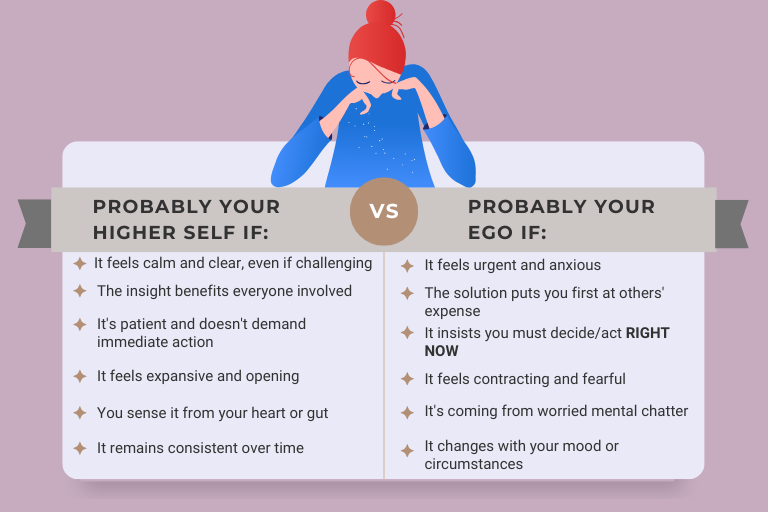
The ego isn’t the villain—it’s just trying to protect you based on past experiences. But your Higher Self sees a bigger picture beyond immediate safety and comfort.
This Journey Takes Time (And That’s OK)
Connecting with your Higher Self isn’t a one-and-done achievement. Most of us experience it in glimpses—moments of clarity and alignment that gradually become more frequent as we practice noticing them.
Some days you’ll feel deeply connected, and other days you’ll be certain your Higher Self has packed up and moved to another dimension. That’s normal. The path isn’t about perfection—it’s about gently returning to center each time you drift, with a little more awareness each round.
Remember: Your Higher Self isn’t some idealized, perfect version of you that you need to become. It’s the authentic core that’s already there beneath the noise and conditioning. Your job isn’t to create it, but to clear away what blocks it.

5 FAQ Questions & Answers
Q1: What is the difference between the higher self and the ego?
The ego is the part of you shaped by fear, past wounds, and the need for external validation. Your higher self exists beneath all of that – it’s the calm, wise, loving version of you that isn’t threatened by circumstances. While the ego reacts, the higher self responds.
Q2: Is the higher self a spiritual or psychological concept?
It’s both. Spiritually, it’s often described as your soul or truest essence. Psychologically, it aligns with concepts like your authentic self or inner wisdom – the part of you that knows what you truly need, separate from learned beliefs and conditioning.
Q3: How do I know when I’m disconnected from my higher self?
Common signs include chronic self-doubt, people-pleasing, emotional numbness, feeling like you’re living someone else’s life, or struggling to make decisions without external reassurance. Reconnection often begins with slowing down and listening inward.
Q4: Can trauma block you from connecting with your higher self?
Yes. Childhood wounds, family trauma, and emotional pain can create layers of defense that make it hard to access your deeper self. Healing that inner layer – through practices like journaling, meditation, or inner child work – is often what allows the higher self to emerge.
Q5: How long does it take to connect with your higher self?
There’s no set timeline – for some it happens in a single quiet moment, for others it’s a gradual unfolding over months or years. What matters most is consistency: small daily practices of stillness, self-inquiry, and self-compassion build the bridge over time.
“This article reflects personal experience and is not a substitute for professional therapy.”
Want daily reminders to connect with your Higher Self? Follow us on Instagram @_selflovematters_ for practical tips, meditations, and a community of fellow seekers.