
Do you ever wonder why certain situations trigger an emotional reaction that feels out of proportion? Or why you struggle to set boundaries, trust others, or feel “enough”? These questions often trace back to the wounded inner child—a part of you that carries the pain, fear, and unmet needs of your early years.
Healing your inner child is not just a trendy concept; it’s an essential step toward emotional freedom and building healthier relationships. In this article, we’ll explore how childhood wounds manifest in adulthood, share real-life examples, and provide actionable steps and techniques to help you reconnect with and heal your inner child.
Table of Contents

1. What Is the Inner Child?
The inner child is the emotional, vulnerable part of us shaped during our formative years. It’s the voice that carries the excitement of our first playtime and the tears of our unmet needs. When this child is wounded—through neglect, criticism, or trauma—it carries those unhealed emotions into adulthood.
Case in Point:
Emma, a successful professional in her 30s, found herself constantly overachieving to prove her worth. During therapy, she realized that her parents had rarely praised her as a child. This lack of validation shaped her belief that love was conditional upon achievement.
When we neglect the inner child, it often shows up in our adult lives as perfectionism, people-pleasing, or self-doubt. Recognizing this connection is the first step to healing.
2. How Childhood Wounds Manifest in Adult Life
The table below provides a detailed look at how different childhood wounds affect adult behaviors:
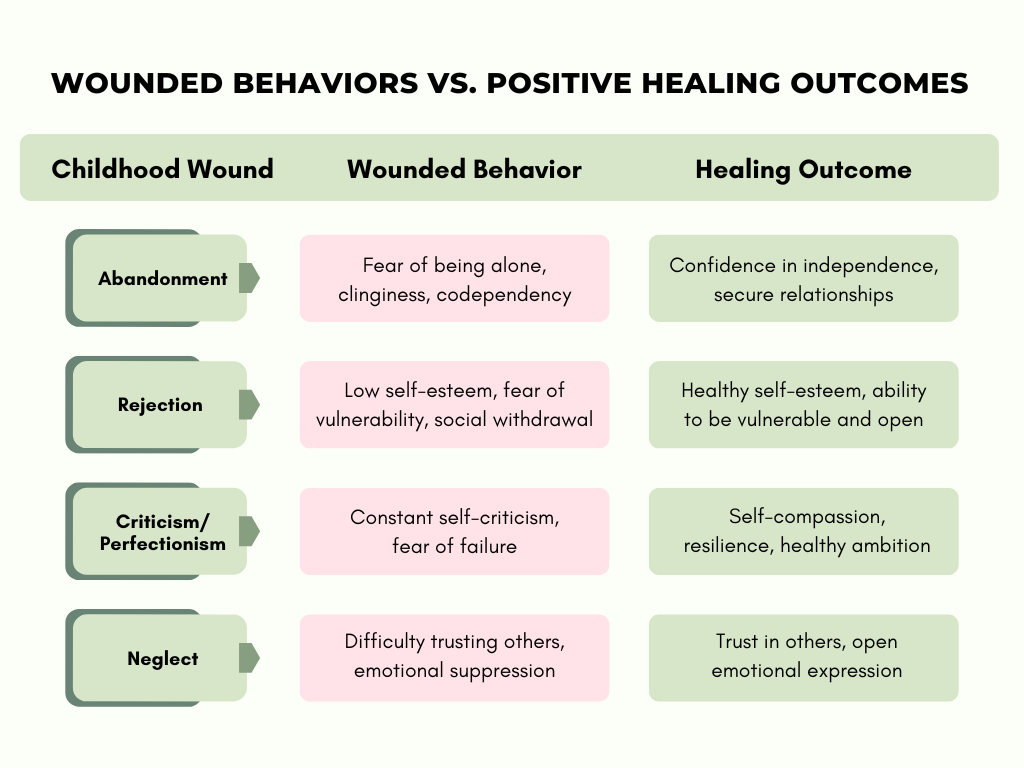
These patterns can lead to recurring challenges in relationships, careers, and mental health, but they are not permanent. Healing begins with awareness.
3. The Impact on Relationships and Personality
Unhealed wounds often create challenges in personal relationships:
- Fear of Intimacy: Difficulty trusting others or opening up emotionally.
- Conflict Avoidance: Fear of being abandoned or rejected leads to suppressing needs.
- Overattachment: Seeking validation from others at the expense of your own well-being.
Personal Story:
Jacob, a 40-year-old entrepreneur, struggled with anger and impatience in his marriage. After attending a healing workshop, he realized his father’s absence had left him feeling emotionally abandoned. This awareness allowed him to share his vulnerability with his partner, strengthening their bond.
When we start healing our inner child, we can form healthier, more connected relationships.

4. Signs You Need Inner Child Healing
Here are some signs your inner child is crying out for attention:
- Emotional overreactions to minor situations.
- Struggles with boundaries—either too rigid or too lenient.
- Constant need for external validation.
- Recurring patterns of self-sabotage.
Recognizing these signs is key to starting your healing journey.
To truly grasp our situation, it’s helpful to take a moment to look within ourselves instead of blaming or criticizing. When we have the courage to face our vulnerabilities, we open the door to becoming the best versions of ourselves. This journey teaches us that understanding who we are isn’t about trying to satisfy others’ expectations. Let’s embrace our unique paths.

5. Techniques to Heal Your Inner Child
5.1 Reparenting Your Inner Child
Reparenting involves giving yourself the love, reassurance, and guidance you may have missed as a child.
- Speak to your inner child: “I see you. I hear you. You’re safe with me now.”
- Visualize holding your younger self and telling them it’s okay to feel scared or sad.
Exercise:
Write a letter to your inner child, acknowledging their pain and promising to care for them moving forward.
5.2 Guided Meditations
Meditation helps create a safe mental space to reconnect with your inner child. Close your eyes, visualize your younger self, and ask them what they need. Listen without judgment.

5.3 Journaling Prompts
Writing can unlock emotions buried deep in your subconscious. Try these prompts:
- “What did I need most as a child that I didn’t receive?”
- “What am I afraid to feel, and why?”
- “How can I show myself love today?”
5.4 Create Joyful Rituals
Your inner child thrives on joy and creativity. Revisit hobbies you loved as a kid—painting, dancing, or building sandcastles. These activities help foster a sense of safety and play.
Real-Life Example:
Rachel began coloring mandalas every evening, a hobby she loved as a child. She found it not only soothing but also a way to express emotions she couldn’t verbalize.

6. Healing in Relationships
Relationships often mirror our inner wounds. Healing together can create profound change.
- Communicate Vulnerabilities: Share your inner child struggles with trusted loved ones.
- Set Boundaries: Practice saying no when something doesn’t feel right, even if it feels uncomfortable at first.
- Seek Support: Therapists trained in Inner Child Therapy or Internal Family Systems can guide you through the process.
7. The Benefits of Healing Your Inner Child
- Greater self-awareness and emotional resilience.
- Healthier, more fulfilling relationships.
- Increased confidence in setting boundaries.
- Freedom from repeating negative patterns.
It’s common for people to think that the effects of an unhealed inner child are just part of growing up, and we often hear phrases like “accept me as I am.” But, if we don’t take the time to address and heal our inner child, we might find ourselves stuck in a cycle of hurting ourselves and the ones we care about.
If you’re looking to create a happier life for yourself, I really encourage you to take a journey to explore and heal that inner child. It can lead to wonderful improvements in your overall happiness and well-being!

8. Conclusion
Healing your inner child is a journey that requires patience, compassion, and practice. By nurturing the wounded parts of yourself, you’ll uncover a wellspring of peace, joy, and authenticity. Remember, healing is not about erasing the past but learning to hold it with love and understanding.
Take the first step today. Journal, meditate, or simply take a moment to tell your inner child: “I’m here for you, and I’ll never leave.”
Explore our curated collection of spiritual wall art on Etsy, designed to inspire your healing journey and create a sanctuary of peace in your space.
5 FAQ Questions & Answers
Q1: Is “inner child healing” a legitimate psychological concept or just a self-help trend?
It’s well-grounded in psychology. The concept draws from the work of therapists like John Bradshaw and is central to established therapeutic approaches such as Internal Family Systems (IFS) and schema therapy. The idea is that early emotional experiences – especially unmet needs – don’t simply disappear; they become internalized beliefs and patterns that continue to influence behavior in adulthood.
Q2: How do I know if my reactions are coming from my inner child?
A useful signal is disproportionality – when your emotional reaction feels much bigger than the situation warrants. If a small criticism sends you into shame spirals, or a minor conflict triggers intense fear of abandonment, your inner child is likely responding. Other clues include people-pleasing, difficulty saying no, perfectionism, and a persistent sense of not being “enough” regardless of what you achieve.
Q3: Can I do inner child healing on my own, or do I need a therapist?
Meaningful progress is absolutely possible on your own through journaling, reparenting practices, guided meditation, and self-compassion work – all covered in this article. That said, for deeper or more complex trauma, working with a therapist trained in inner child work, IFS, or somatic approaches can help you go further and more safely. Both paths are valid; you don’t have to choose one exclusively.
Q4: What does “reparenting yourself” actually mean in practice?
Reparenting means consciously giving yourself what your caregivers couldn’t – the validation, safety, consistency, and compassion that every child needs. In practice, it looks like: speaking to yourself with warmth rather than criticism, acknowledging your feelings before trying to fix them, following through on promises you make to yourself, and allowing rest and joy without guilt. Over time, you become the steady, loving presence your younger self never had.
Q5: How long does inner child healing take?
There’s no fixed timeline, and healing isn’t linear. Some insights arrive quickly; others take months or years to integrate. The goal isn’t to “complete” the work and move on – it’s to develop an ongoing, compassionate relationship with yourself that grows deeper over time. Most people find that consistent small practices, rather than occasional deep dives, create the most lasting change.
“This article reflects personal experience and is not a substitute for professional therapy.”